info.youngmindsacademy@gmail.com
Opening Hours : Monday to Friday - 8 Am to 5 Pm
 info.youngmindsacademy@gmail.com
Opening Hours : Monday to Friday - 8 Am to 5 Pm
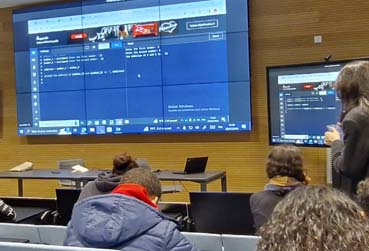
In this comprehensive one-month program, we aim to acquaint students, aged 6-15, with the fundamental principles of computer programming. Through engaging classes and interactive activities, students will grasp the core elements of coding, encompassing data types, variables, control structures, and problem-solving techniques. Upon completion of the course, students will possess a robust grasp of programming concepts and the ability to independently develop basic programs..
Students are expected to possess a rudimentary knowledge of computer operation (e.g., handling program launches, folder navigation, etc.). Additionally, proficiency in English reading and writing is a prerequisite.
Upon completing the course, students will have achieved the following:
1. A firm grasp of fundamental computer programming concepts.
2. The capability to compose straightforward programs using elementary coding principles.
3. Enhanced problem-solving aptitude and creative thinking skills.
4. Valuable experience in collaborative and independent work.
5. A sense of accomplishment and increased confidence in their technological creativity.
This session will present an overview of various programming languages and their practical applications. Students will delve into the fundamental framework of a program and explore how it is executed by a computer.
"Deciphering Programs" In this activity, students will brainstorm various types of programs they encounter in their daily routines. Subsequently, they will craft a visual representation of the structure of one such program using blocks or flowcharts.
In this session, students will dive into the essential principles of programming, covering topics such as loops, conditionals, and events. They will gain proficiency in applying these concepts to construct uncomplicated programs and animations.
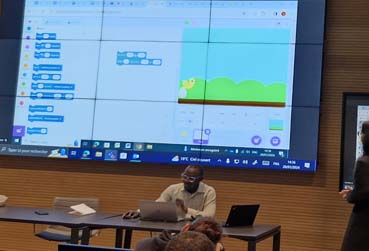
In this hands-on activity, students will utilize Scratch or Code.org's "Hour of Code" tutorials to craft a basic game that integrates loops, conditionals, and events.
This session will delve into the fundamental principles of variables, data types, and operators. Students will acquire the skills to store and manipulate data within a program.
"Number Guessing Challenge" In this engaging activity, students will design a number guessing game that incorporates the use of variables, data types, and operators. In this game, the computer generates a random number, and participants are tasked with guessing the correct number.
This session extends the principles covered in the previous class, guiding students on how to employ loops and conditionals to develop more intricate programs.
In this activity, students will craft a straightforward game that employs loops and conditionals to engage in a game of rock, paper, scissors against the computer.
This session will initiate students into the world of algorithms and flowcharts, indispensable tools for program planning and organization. Students will gain insights into how flowcharts can be employed to depict a program's logic.
"Maze Exploration Adventure" In this activity, students will harness the power of flowcharts to strategize and construct an algorithm that guides them through a virtual maze.
In this session, students will be challenged to construct and execute an algorithm to address a real-world problem through group projects, such as maze navigation or numerical list sorting.
For this activity, students will collaborate in groups to conceive and implement an algorithm for sorting a list of numbers. They can opt for bubble sort or another sorting algorithm of their preference.
This session aims to acquaint students with a range of diverse problem-solving strategies and guide them on their application in various contexts. Students will discover how to leverage their programming prowess to fashion one-of-a-kind and captivating creations.
"Idea Generation Session" - During this activity, students will engage in brainstorming to generate a list of prospective projects that they can develop with their newly acquired programming skills. They will then choose one project to pursue.
In this class, students will have the opportunity to put into practice the skills and concepts they've acquired over the course of the month. They will bring together their knowledge to produce a final project.
In this activity, students can opt to work independently or collaborate in groups to design and create a final project, utilizing the programming skills and concepts they've mastered throughout the month.

I am Ibidunni Ridwan, an alumna with a degree in Mathematics from Adekunle Ajasin University, currently pursuing a master's degree in Collective Intelligence at University Mohammed VI Polytechnic (UM6P). My journey into programming ignited during my undergraduate studies and has evolved into this thrilling adventure. As your mentor at YoungMindAcademy, I am eager to guide you through the captivating realm of coding and programming. Fueled by a deep passion for education and technology, I bring a decade of experience to the classroom, fostering an interactive and supportive environment for young learners. .

There are many variations of passages of Lorem Ipsum available, but the majority have suffered alteration in some form, by injected humour, or randomised words which.

There are many variations of passages of Lorem Ipsum available, but the majority have suffered alteration in some form, by injected humour, or randomised words which.

There are many variations of passages of Lorem Ipsum available, but the majority have suffered alteration in some form, by injected humour, or randomised words which.